
Review of Best Small Fictions 2025
By David Galef
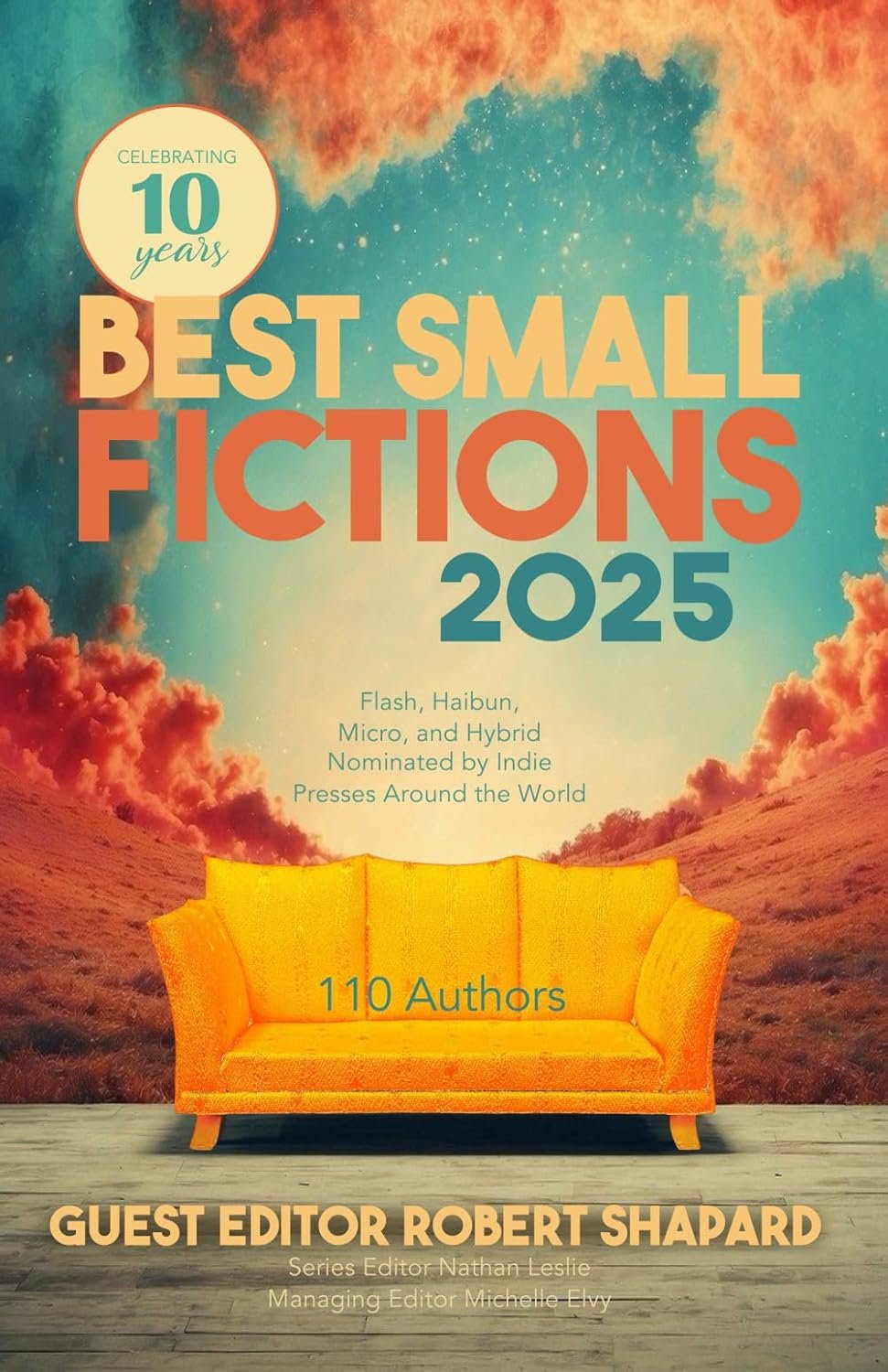
This 10th-year anniversary edition of Best Small Fictions features 110 stories with a lot of arresting imagery, particularly metaphors building to last lines that tilt the whole narrative on its axis. We may have known this but never put in such a way.
In fact, the reorientation begins with titles, as in Avitus B. Carle’s “You Work in the Worst Diner in Existence That’s Always Open for Business,” then opening sentences: “On the morning of his death, Dumont is late” (Brady Brickner-Wood). Note to submitters: This is how to catch a jaded editor’s eye.
This year’s collection is much more about loss than about achievement, as in Emily Rinkema’s “Driving My Seven-Year-Old Nephew to Visit His Mother at Rehab,” which starts out with a game of Would You Rather: “It’s a game we’ve been playing together since he could talk, since he started spending nights at my apartment, since he learned about worst-case scenarios that didn’t involve choice”; or Thaddeus Rutkowski’s “Crossing,” which moves from a husband visiting his wife in the hospital to a mutual dependency: “We were holding onto each other because that was the way to survive.”
Perhaps as a counter-charm, Nicola Koh’s “I’ve Been Getting Letters from Santa for Twenty Years and All I’ve Learned Is He’s an Asshole” is, to use a technical term, a hoot.
The technical bravura award goes to “What Would the Aliens Think?” (Ekpenyong Kosisochukwu Collins), all in the second-person conditional. Toward the ultra-miniature, Scott Garson’s “Lottery,” spanning a whole relationship in a mere 134 words, is based simply on two tickets.
Sketches etched in surrealism are often indelible, particularly in works like Epiphany Farrell’s “Based on a True Story,” in which “A rainbow trout used my phone to call his mother.” Admittedly, surrealism may occasionally serve as an excuse to avoid plot, but oneiric incidents have their own narrative logic.
And then along comes a rarity, a whole life studded with incident and characters, not just a metonymic scrim: “She was brought into the country under the whispers of rough voices and the smell of motor oil, the ocean pulling against them. She was sold under a quay and spent her childhood on a flat-bottomed boat, poling the river that snaked from the capital into wild land. The man who bought her bought her to ease his loneliness”—from Caitlyn Kinsella’s “The Long Walk North.”
So many of the stories are hermetically personal that to be reminded of the political and historical realm (beyond the U.S.) is salutory. Ruben Reyes, Jr.’s “Alternate Histories of El Salvador or Perhaps the World” presents both tragedy and involuntary farce: “Thousands of Pipil stand before the Spanish soldiers with spears in their hands, obsidian blades pointed toward the rain clouds, as they prepare for a battle that will determine who stays and who leaves this land they know as Cuscatlán or San Salvador; one name Spanish, one name true.”
Apologies to the many unheralded yet deserving stories here, but this review stops at 500 words.
Full acknowledgment: This collection features many Vestal Review contributors, including two stories we published: Aimee Bender’s “Evacuated” and Debabrata Sahoo’s “An Inexhaustive List of Places Where You Grieved for Your Mother”; as well as a piece by one of our editors, Lucy Zhang’s “Layered House.” Mandira Pattnaik, also on our editorial staff, served this year as one of the editors of this anthology.

David Galef: See Masthead.